что такое gdp per capita
Per capita GDP
Смотреть что такое «Per capita GDP» в других словарях:
Per Capita GDP — A measure of the total output of a country that takes the gross domestic product (GDP) and divides it by the number of people in the country. The per capita GDP is especially useful when comparing one country to another because it shows the… … Investment dictionary
Per capita income — means how much each individual receives, in monetary terms, of the yearly income generated in the country. This is what each citizen is to receive if the yearly national income is divided equally among everyone. Per capita income is usually… … Wikipedia
per capita — per cap‧i‧ta [pə ˈkæptə ǁ pər ] adverb ECONOMICS for or by each person: • Japanese visitors spending per capita was much higher than average spending by tourists from other countries. • The US uses twice as much oil per capita as European… … Financial and business terms
GDP per capita — UK US noun [U] ECONOMICS ► the total value of all the goods and services produced in a country in a particular year, divided by the number of people living there: »Ireland s GDP per capita was above the EU average. → Compare GNP(Cf. ↑GNP) … Financial and business terms
per capita — Latin expression meaning by head (of population). The phrase is commonly used in the context of economic statistics: Examples are per capita *Gross Domestic Product (GDP) and per capita *consumption … Auditor’s dictionary
Comparison between Argentine provinces and countries by GDP (PPP) per capita — This is a comparison between Argentine provinces and countries by Gross Domestic Product (PPP) per capita. All data is for the year 2008. These figures are based on the IADER list on List of Argentine provinces by GDP (nominal) per capita for… … Wikipedia
List of cities in the People’s Republic of China by GDP per capita — This list hopes to rank cities of the People s Republic of China by GDP per capita in Renminbi (), aka yuan ().According to administrative divisions of China, there are three level of cities: municipalities, prefecture level cities, and county… … Wikipedia
List of countries by GDP per capita — There are two articles listing countries according to their per capita GDP:*List of countries by GDP (nominal) per capita GDP at market or government official exchange rates per habitant *List of countries by GDP (PPP) per capita GDP calculated… … Wikipedia
List of Saudi cities by GDP per capita — This article includes a list of the main Saudi cities sorted by their Gross Domestic Product (GDP) per capita, [ [http://www.payscale.com/research/SA/Country=Saudi Arabia/Salary/by City Saudi Cities by Median Salary (GDP Per Capita)] ] the list… … Wikipedia
List of countries by GDP (nominal) per capita — This article includes three lists of countries of the world sorted by their gross domestic product per capita at nominal values, the value of all final goods and services produced within a nation in a given year, converted at market exchange… … Wikipedia
GDP per capita, consumption per capita and price level indices
Data from 21 June 2021
Planned article update: 15 December 2021
Volume indices of GDP per capita, 2020
This article presents the most recent analysis of purchasing power parities and related economic indicators (gross domestic product (GDP) per capita, level of actual individual consumption (AIC) per capita, countries’ price level indices) in the European Union (EU) and the countries mentioned below for the years 2018, 2019 and 2020, focusing primarily on the latest reference year. The countries included in the comparison are the 27 EU Member States, three EFTA countries (Iceland, Norway and Switzerland), United Kingdom, five EU candidate countries (Albania, Montenegro, North Macedonia, Serbia and Turkey) and one potential candidate country (Bosnia and Herzegovina).
Overview
In 2020, Ireland recorded the second highest level of GDP per capita in the EU, at 111% above the EU average, with only Luxembourg at a higher level. Bulgaria was the Member State with the lowest GDP per capita, at 45% below the EU average. Levels of actual individual consumption were somewhat more homogeneous, but still showed significant differences across Europe. Luxembourg recorded the highest level of AIC per capita in the EU, at 31% above the EU average, as well as the highest price level, at 53% above the EU average.

Relative volumes of GDP per capita
In international comparisons of national accounts data, like GDP per capita, it is desirable not only to express the figures in a common currency, but also to adjust for differences in price levels. Failing to do so would result in an overestimation of GDP levels for countries with high price levels, relative to countries with low price levels.
Countries’ volume indices of GDP per capita are shown in the left-hand part of Table 1. The dispersion in GDP per capita across the EU Member States is quite remarkable. Luxembourg has by far the highest GDP per capita among all the 37 countries included in this comparison, being more than two and a half times above the EU average. This is partly explained by the fact that a large number of foreign residents are employed in the country and thus contribute to its GDP, while they are not included in the resident population.

Ireland comes out second among the EU Member States, at 111% above the EU average, followed by Denmark, the Netherlands, Austria, Sweden and Germany, each with a GDP per capita more than 20% above the average. The EFTA countries Switzerland, Norway and Iceland have a level of GDP per capita of 60%, 42% and 25% above the EU average, respectively.
Belgium, Finland and France are the other EU Member States with a GDP per capita above the EU average, followed by the United Kingdom. Malta, Italy and Czechia have a level of GDP per capita of less than 10% below the EU average. Slovenia, Lithuania, Cyprus, Estonia and Spain have a GDP per capita between 10% and 20% below the EU average. The GDP per capita of Portugal, Poland, Hungary, Latvia, Romania and Slovakia is less than 30% below the average. Croatia, Greece, and the candidate country Turkey have a GDP per capita of less than 40% below the average. Bulgaria is placed at 45% below the EU average, followed by the candidate countries Montenegro, Serbia, North Macedonia, Bosnia and Herzegovina (potential candidate country) and Albania.
Relative volumes of consumption per capita
While GDP is mainly an indicator of the level of economic activity, Actual Individual Consumption (AIC) is an alternative indicator better adapted to describe the material welfare of households.
Countries’ volume indices of AIC per capita can be found in the right-hand part of Table 1. Generally, levels of AIC per capita are more homogeneous than GDP but still there are substantial differences across the EU Member States.
Luxembourg has the highest level of AIC per capita among all 37 countries included in this comparison at 31% above the EU average. It is followed by the EFTA countries Norway, Iceland, Switzerland and EU Member States Germany and Denmark, with AIC per capita at 28%, 24%, 23%, 23% and 21% above the EU average, respectively. While Luxembourg can be said to belong to «a division of its own» in terms of GDP, this is less so for AIC. One reason for this is that cross-border workers contribute to GDP in Luxembourg while their consumption expenditure is recorded in the national accounts of the country of their residence. Ireland, having the second highest level of GDP per capita in the EU, has an AIC per capita at 6% below the EU average.
Price levels in Europe
Table 2 shows countries’ price levels to the right, with the EU average at 100, for AIC only. It also shows the exchange rates applied in the calculation of the price level indices (see methodology described in Data sources). In the following, the discussion is restricted to the price levels of AIC, since this is closer to the concept of price levels that people are familiar with than a price level indicator based on GDP.

Luxembourg has the highest price levels among the Member States, 53% above the EU average. However, the EFTA countries Switzerland, Norway and Iceland have higher price levels, at 80%, 49% and 47% above the EU average, respectively. The EU Member States Denmark, Sweden, Ireland and Finland have price levels more than 20% above the EU average. The United Kingdom has a price level 24% above that average. Austria, The Netherlands, Belgium, France, Germany and Italy are the other EU Member States with price levels above the EU average.
Spain and Cyprus have a price level less than 10% below the EU average, followed by Malta, Portugal, Slovenia, Greece, Estonia and Slovakia at less than 20% below the EU average. Latvia has a price level situated less than 30% below the EU average, followed by Czechia (30% below the EU average), Lithuania and Croatia with price levels less than 40% below that average. Hungary, Poland, followed by the candidate countries Albania, Serbia, EU Member State Bulgaria, the potential candidate country Bosnia-Herzegovina and Montenegro (candidate country) have price levels between 40% and 50% below the EU average. The Member State Romania, the candidate countries North Macedonia and Turkey (68% below that average) all have price levels more than 50% below the EU average.
Exchange rates are crucial in determining price levels, and exchange rate movements consequently often have a big impact on the development of price levels over time. In fact, several of the major price level changes observed between 2018 and 2020 can be at least partly explained by fluctuations of a country’s currency against the Euro. In 2019 and 2020, the national currency of Turkey showed a large depreciation against the Euro; the same country shows the largest decrease of price levels between 2018 and 2020.
The last three rows in Table 2 show the coefficients of variation of the price levels for three groups of countries: the euro area (EA-19), the EU Member States (EU) and the entire group of 37 countries. A time series of these coefficients can be interpreted as a rudimentary price convergence indicator.
These figures show that, firstly, and unsurprisingly, the price dispersion is much less pronounced in the euro area than in the EU as a whole and in the 37-country group, which can be partially impacted by the volatility of exchange rates. Secondly, over this three-year period, price levels are very slightly converging within EA-19, EU and for all 37 countries.
Data sources
The data in this article are produced by the Eurostat-OECD Purchasing power parities programme. The full methodology used in the programme is described in the Eurostat-OECD Methodological manual on purchasing power parities.
Purchasing power parities (PPPs) are currency conversion rates that are applied in order to convert economic indicators from national currency to an artificial common currency, called the Purchasing Power Standard (PPS), which equalizes the purchasing power of different national currencies and enables meaningful volume comparisons between countries. For example, if the GDP or AIC per capita expressed in the national currency of each country participating in the comparison is divided by its PPP, the resulting figures neutralise the effect of differences in price levels and thus indicate the real volume of GDP or AIC at a common price level. When divided by the nominal exchange rate of a given year, the PPP provides an estimate of the price level of a given country relative to, for instance, the EU total.
PPPs are established on an annual basis. According to the regular publication calendar, PPPs are released as preliminary estimates 12 months after the end of the reference year and revised after 24 months, while the final results are released 36 months after the end of the reference year. In addition, an early estimate of PPPs, partly based on projections, is published 6 months after the end of the reference year. This regular PPP revision and release calendar is in line with the data delivery timetable for national accounts data as given in the ESA 2010 Regulation 549/2013 of 21 May 2013. Thus, the 2018 results presented in this publication should be regarded as final, while the 2019 and 2020 results are still preliminary.
In their simplest form PPPs are nothing more than price relatives that show the ratio of the prices in national currencies for the same good or service in different countries. For example, if the price of a hamburger in France is 2.84 euro and in the United Kingdom it is 2.20 pound sterling, the PPP for hamburgers between France and the United Kingdom is 2.84 euro to 2.20 pounds or 1.29 euro to the pound. In other words, for every pound spent on hamburgers in the United Kingdom, 1.29 euro would have to be spent in France in order to obtain the same quantity and quality – or volume – of hamburgers.
The indices of relative volumes of GDP and AIC per capita published in this article have been adjusted for price level differences, and are expressed in relation to the European Union average (EU=100). Thus, for instance, if a country’s volume index is below 100, that country’s level of GDP (or AIC) per capita is lower than for the EU as a whole. The price level adjustment factors, referred to as purchasing power parities, can also be used in comparison of countries’ price levels.
Price level indices (PLIs) as presented in this publication are the ratios of PPPs to exchange rates. They provide a measure of the differences in price levels between countries by indicating for a given product group the number of units of common currency needed to buy the same volume of the product group or aggregate in each country. They are presented relative to the European Union average: if the price level index is higher than 100, the country concerned is relatively expensive compared to the EU average and vice versa. The EU average is calculated as the weighted average of the national PLIs, weighted by the expenditures corrected for price level differences.
Volume and price level indices are not intended to rank countries strictly. In fact, they only provide an indication of the order of magnitude of the volume or price level in one country in relation to others, particularly when countries are clustered around a very narrow range of outcomes. The level of uncertainty associated with the basic price and national accounts data, and the methods used for compiling PPPs imply that differences between countries that have indices within a close range should not be over-interpreted.
In national accounts, Household Final Consumption Expenditure (HFCE) denotes expenditure on goods and services that are purchased and paid for by households. Actual Individual Consumption (AIC), on the other hand, consists of goods and services actually consumed by individuals, irrespective of whether these goods and services are purchased and paid for by households, by government, or by non-profit organisations. In international volume comparisons, AIC is often seen as the preferable measure, since it is not influenced by the fact that the organisation of certain important services consumed by households, like health and education services differs a lot across countries. For example, if dental services are paid for by the government in one country, and by households in another, an international comparison based on HFCE would not compare like with like, whereas one based on AIC would.
Context
Eurostat is co-operating closely with other international institutions in the production and dissemination of PPPs. It co-operates with the OECD to produce PPP statistics for the OECD countries and with the World Bank and the International Monetary Fund (IMF) to produce global PPP data. See external links below.
For more information
The COVID-19 pandemic has affected the price collection for purchasing power parities (PPPs) during 2020 and the estimation of 2020 expenditures used in the calculation of the first estimates of 2020 PPPs. More information is available here.
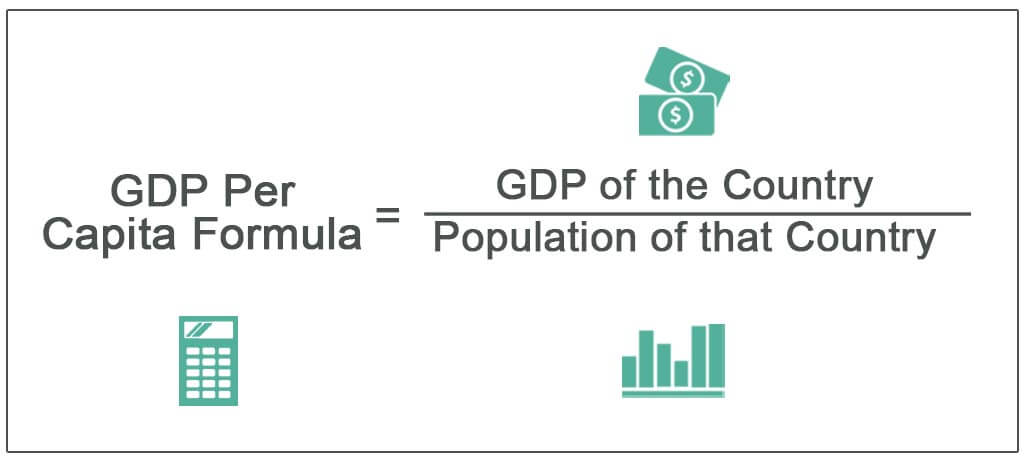
GDP Per Capita Formula


Formula to Calculate GDP Per Capita of the Country
GDP per capita formula calculates the average of the nation’s economic output when divided by the total population. In other words, it is the equal apportioning of the gross domestic product for each resident to represent the country’s standard of living.
The formula for calculating GDP Per Capita is represented as follows
You are free to use this image on your website, templates etc, Please provide us with an attribution link How to Provide Attribution? Article Link to be Hyperlinked
For eg:
Source: GDP Per Capita Formula (wallstreetmojo.com)
Examples
Example #1
Solution
Use below given data for calculation of GDP Per Capita.
Calculation of GDP Per Capita can be done as follows:
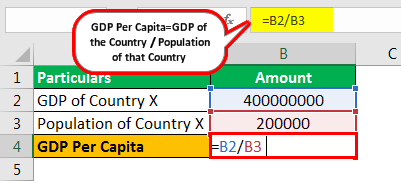
GDP Per Capita will be –
Example #2
Country MCX is trying to figure out the GDP of the country and also then wants to know what the GDP is and per capita of the country. The statistic Statistic Statistics is the science behind identifying, collecting, organizing and summarizing, analyzing, interpreting, and finally, presenting such data, either qualitative or quantitative, which helps make better and effective decisions with relevance. read more department of the government has provided them with the below data:
Use below given data for calculation of GDP Per Capita.
| Particulars | 2017 | 2018 |
|---|---|---|
| Private Consumption | 1330000000.00 | 1945790000.00 |
| Gross Investment | 465500000.00 | 742938000.00 |
| Government Investment | 6650000000.00 | 9021390000.00 |
| Imports | 997500000.00 | 1180740750.00 |
| Exports | 3325000000.00 | 4554917500.00 |
The elections of the nation are due next year, and the president is concerned if they made growth in GDP per capita? As per the last census conducted, the population of the country is 3,237,450,050. It was estimated that the population since the last census would have grown at 3% and 5% for the year 2017 and 2018 respectively.
Based on available information, you are required to estimate the GDP Per Capita.
Solution
The GDP figure is not mentioned directly here and therefore we shall calculate the GDP of the country first by using the expenditure method in which all the investment is added and only imports are deducted.
GDP of the country for the Year 2017 is as follows
GDP of the country for the Year 2018 is as follows
Further, there has been also growth in the population of the country.
The population has grown by 3% and 5% for the year 2017 and 2018 based upon the last census count.
Population of the Country for the Year 2017 is as follows –
Population of the Country for the Year 2018 is as follows –
Therefore, calculation of GDP Per Capita for the Year 2017 is as follows
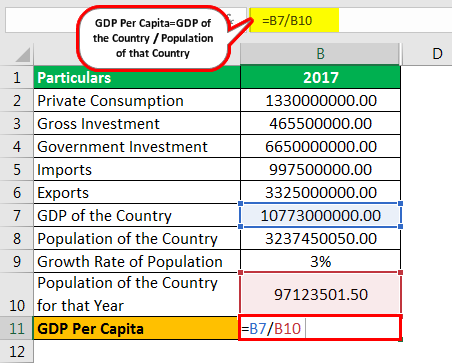
GDP Per Capita will be –
Therefore, calculation of GDP Per Capita for the Year 2018 is as follows
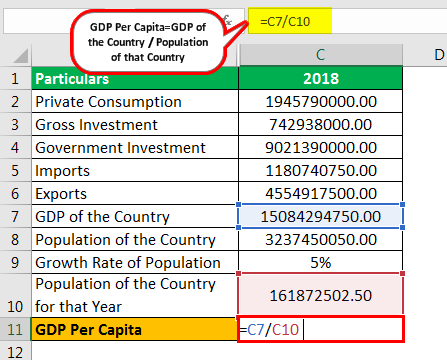
GDP Per Capita will be –
Therefore, the GDP per capita of country MCX has diminished from the year 2017.
Example #3
As per the data available on the worldpopulationview.com, the GDP and the population of the various countries are available per below:
Use below given data for calculation of GDP Per Capita.
| Particulars | USA | China | Japan | India | United Kingdom |
|---|---|---|---|---|---|
| GDP | 21410230000000 | 15543710000000 | 5362220000000 | 3155230000000 | 3022580000000 |
| Population | 329064917 | 1433783686 | 126860301 | 1366417754 | 67530172 |
You are required to calculate the GDP Per Capita and comment upon the same.
Solution
Therefore, the calculation of GDP Per Capita is as follows

GDP Per Capita will be –
Similarly, we can calculate GDP Per Capita for other countries as shown below

It can be observed that the population of India and China is more and hence their GDP per capita is depicting a low figure. Further, the GDP of India is more than the United Kingdom but again due to its oversize population, it’s showing that India is way behind than UK which doesn’t appear when only GDP is compared. The USA is doing well in absolute GDP and per capita as well. Japan is having the advantage of a lower population and hence it’s per capita is good.
Recommended Articles
This has been a guide to GDP Per Capita Formula. Here we discuss how to calculate GDP per capita along with practical examples and template. You can learn more about economics from the following articles –